For many students in Pakistan, choosing the pre-medical track in FSc or A-Levels is often associated with a single goal: becoming a doctor. Traditionally, degrees such as MBBS and BDS have been considered the most prestigious and sought-after career paths for science students.
However, the healthcare sector is evolving rapidly. Today, pre-medical students have access to a much wider range of career opportunities beyond traditional medical practice.
From allied health sciences and biotechnology to digital health and biomedical engineering, the modern healthcare system offers diverse pathways where students can contribute to improving lives and advancing medical science.
Understanding these options can help students make informed decisions about their future careers.
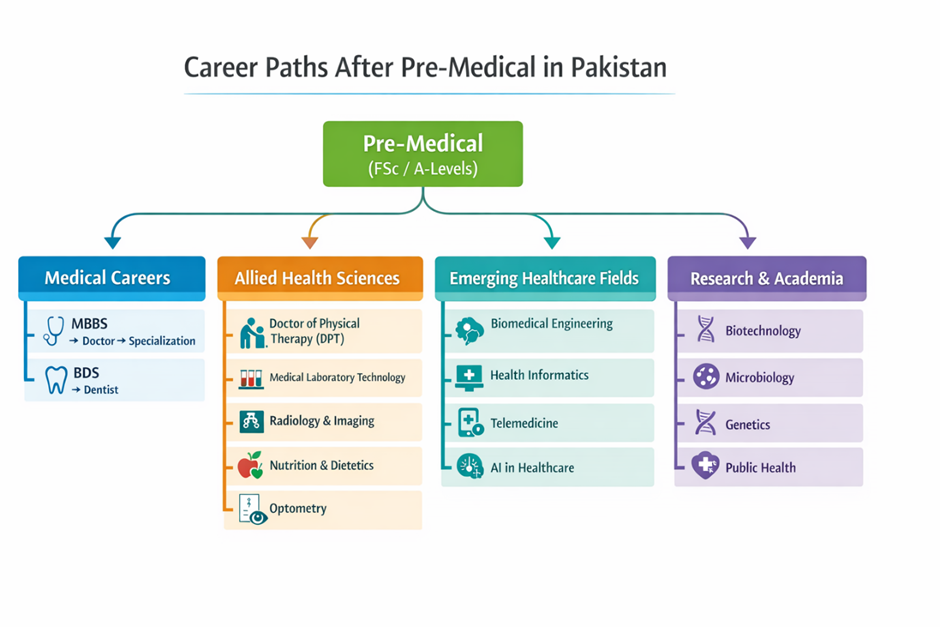
🧑⚕️ Traditional Medical Careers
For many students, the primary goal after pre-medical studies is admission to medical or dental colleges.
🩺 MBBS – Bachelor of Medicine, Bachelor of Surgery
MBBS remains the most popular career path for pre-medical students. After completing their degree, doctors can pursue specialization in fields such as:
- Cardiology
- Surgery
- Paediatrics
- Dermatology
- Radiology
- Psychiatry
Specialization allows doctors to build rewarding careers both in Pakistan and internationally .
😁 BDS – Bachelor of Dental Surgery
Dentistry is another respected profession within the healthcare sector. Dentists may specialize in areas such as:
- Orthodontics
- Oral surgery
- Cosmetic dentistry
- Periodontology
With the increasing demand for dental care and cosmetic procedures, many dentists establish successful private clinics.
🧪 Growing Opportunities in Allied Health Sciences
In recent years, allied health sciences have become one of the fastest-growing career areas for pre-medical students.
These professions support doctors and play a vital role in modern healthcare systems.
Popular programs include:
- 🦵 Doctor of Physical Therapy (DPT)
- 🔬 Medical Laboratory Technology
- 🩻 Radiology and Imaging Technology
- 🥗 Nutrition and Dietetics
- 👁 Optometry
- 🗣 Speech and Language Therapy
Pakistan’s healthcare system requires more trained paramedics, therapists, and laboratory specialists, making these careers increasingly valuable.
💻 Emerging Careers in Modern Healthcare
Healthcare is becoming increasingly technology-driven, creating new and exciting career opportunities for pre-medical graduates.
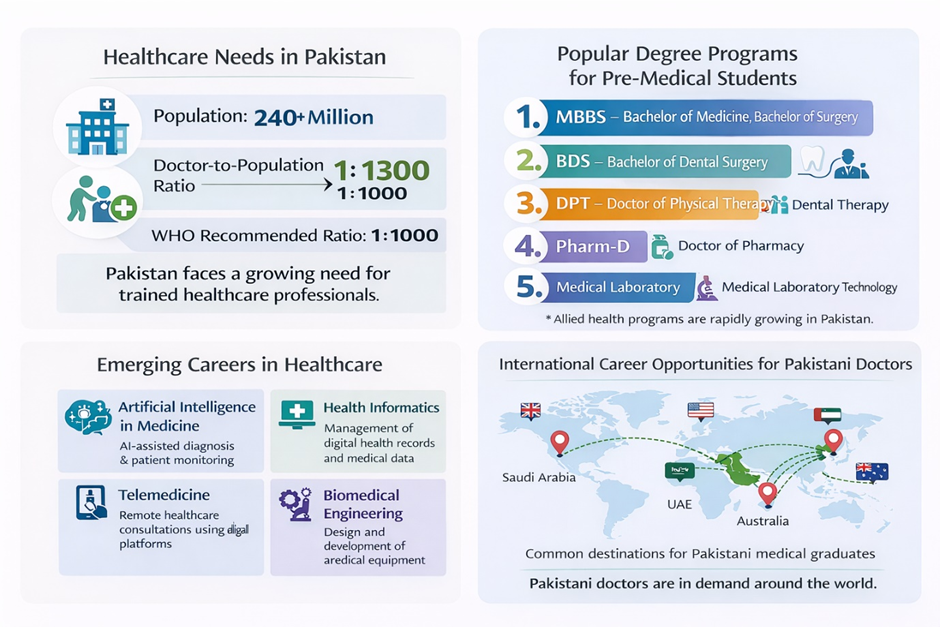
🤖 Artificial Intelligence in Medicine
AI technologies are being used to assist doctors in diagnosis, medical imaging, and patient monitoring.
📊 Health Informatics
Health informatics specialists manage digital medical records and healthcare data systems used by hospitals and clinics.
📱 Telemedicine
Telemedicine platforms allow doctors to consult patients remotely, improving healthcare access in rural areas.
⚙️ Biomedical Engineering
Biomedical engineers design and develop medical equipment, devices, and healthcare technologies.
These emerging fields combine science, technology, and medicine, opening interdisciplinary career paths.
🔬 Careers in Research and Academia
In addition to clinical careers, pre-medical students can also pursue careers in research and education, which play a crucial role in the advancement of medical science and healthcare.
Medical researchers work on developing new medicines, studying diseases, improving diagnostic methods, and advancing medical technology. Their work contributes to major breakthroughs in areas such as vaccines, cancer treatment, genetics, and public health.
Students can pursue careers in research through fields such as:
- Biotechnology
- Microbiology
- Genetics
- Pharmacology
- Biomedical Sciences
- Public Health
- Clinical Research
After completing a bachelor’s degree, students can specialize further through MPhil , MS, or PhD programs and work as:
- Research scientists
- University lecturers or professors
- Clinical research associates
- Public health researchers
- Pharmaceutical researchers
Universities, research institutes, hospitals, and pharmaceutical companies all require skilled researchers and academic professionals. With the global growth of medical research and biotechnology, careers in research and academia offer excellent long-term opportunities for pre-medical students who are interested in scientific discovery and teaching.
🌍 International Career Opportunities
Pakistani medical graduates are recognized worldwide for their strong training and professional expertise.
Many doctors pursue careers or advanced training in countries such as:
- United Kingdom
- United States
- Saudi Arabia
- United Arab Emirates
- Australia
Healthcare systems in many countries actively recruit international doctors to address workforce shortages.
As a result, Pakistani doctors continue to build successful careers around the world.
⚠️ Challenges Facing Pre-Medical Students
Despite the promising opportunities, students pursuing pre-medical studies also face several challenges.
📚 Highly Competitive Admissions
Admission to medical colleges is extremely competitive due to limited seats and high demand.
⏳ Long Training Period
Becoming a specialist doctor can take 10–12 years of education and training.
🏥 Limited Healthcare Infrastructure
Some areas of the country still lack sufficient healthcare facilities and training opportunities.
✈️ Brain Drain
Many doctors leave Pakistan for better training opportunities and working conditions abroad.
Understanding these challenges helps students plan their career paths more effectively.
🚀 Why the Future Remains Promising
Despite these challenges, the outlook for pre-medical students remains strong because:
- Healthcare demand continues to grow
- Population growth requires more medical professionals
- Technology is creating new healthcare careers
- Global demand for doctors and healthcare workers remains high
Students who explore diverse career paths and develop strong skills can build meaningful and successful careers in the healthcare sector.
🎓 Navigating the Competitive Landscape: The Role of Structured Preparation
While the future for pre-medical students is diverse, the immediate gateway—the entry test—remains a rigorous challenge. With a limited number of seats and an ever-increasing pool of candidates, moving from studying hard to studying strategically is often the deciding factor. This is where a specialized support system becomes an essential part of a student’s roadmap.
⭐ Resource Spotlight: KIPS Preparation Framework
KIPS has established itself as a cornerstone for medical entry test preparation in Pakistan by focusing on a holistic, result-oriented environment. Its approach is designed to reduce the friction of exam prep through:
- Expert Mentorship: Guidance from a medical faculty that understands the nuances of the entry test.
- Systemic Alignment: A curriculum and MCQ bank strictly aligned with PMDC standards.
- Simulated Testing: An OMR-based testing system that familiarizes students with the actual exam format, paired with detailed follow-up lectures to address gaps in understanding.
- Data-Driven Insights: Advanced result analysis and an integrated LMS that help students identify and strengthen their weak areas.
💻 KIPS Virtual: Bridging the Gap Through Technology
For students requiring flexibility, KIPS Virtual offers a comprehensive digital ecosystem. This platform ensures that high-quality resources are accessible regardless of geography:
- On-Demand Learning: Access to live and recorded e-lectures, digital notes, and e-books.
- AI-Enhanced Study: Featuring KAIA, a personal AI tutor that assists with personalized study planning and adaptive quizzes.
- Continuous Evaluation: Performance analytics and leaderboards to help students gauge their standing in a nationwide pool.
🚀 Final Words
The journey for a pre-medical student in Pakistan is demanding yet filled with immense potential. Whether your path leads to MBBS, BDS, the rapidly evolving fields of Allied Health Sciences, or emerging careers in modern healthcare, success is built on a foundation of early planning and the right tools. By leveraging structured systems and expert guidance, students can transform the daunting challenge of entry tests into a clear, manageable step toward a rewarding medical career.